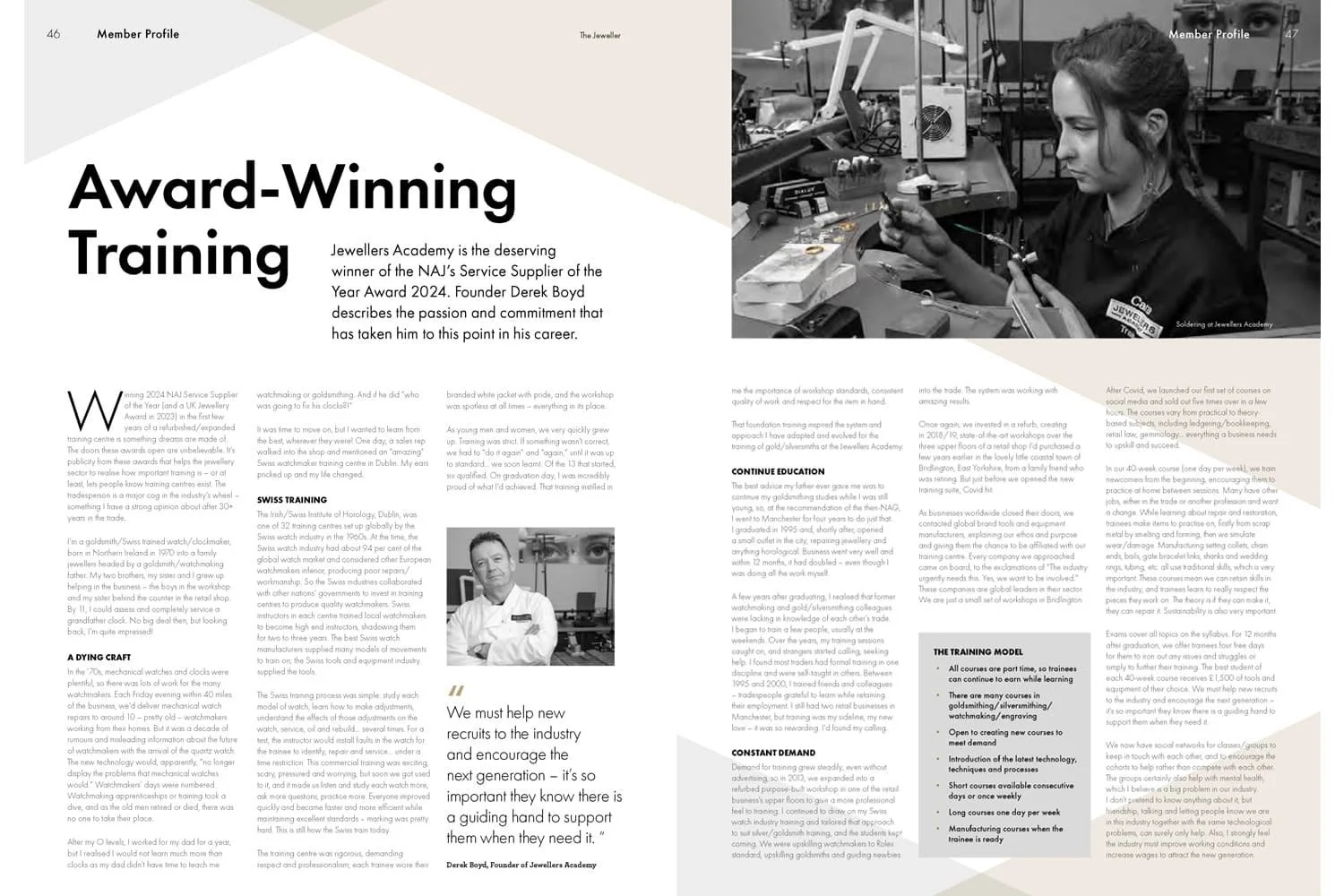
Derek's Interview For The NAJ Spring Issue Of 'The Jeweller' Trade Journal 2025
We were thrilled that Derek was interviewed for the Spring issue of 'The Jeweller' trade journal from the National Association Of Jewellers. The article covers Derek's experience in the industry and the history of our award winning training centre, as well as discussing his training model and the importance of continuing education both individually and in the industry as a whole, which is why demand has been growing for the courses we offer as students look to learn the essential skills that help them progress and thrive in our industry.
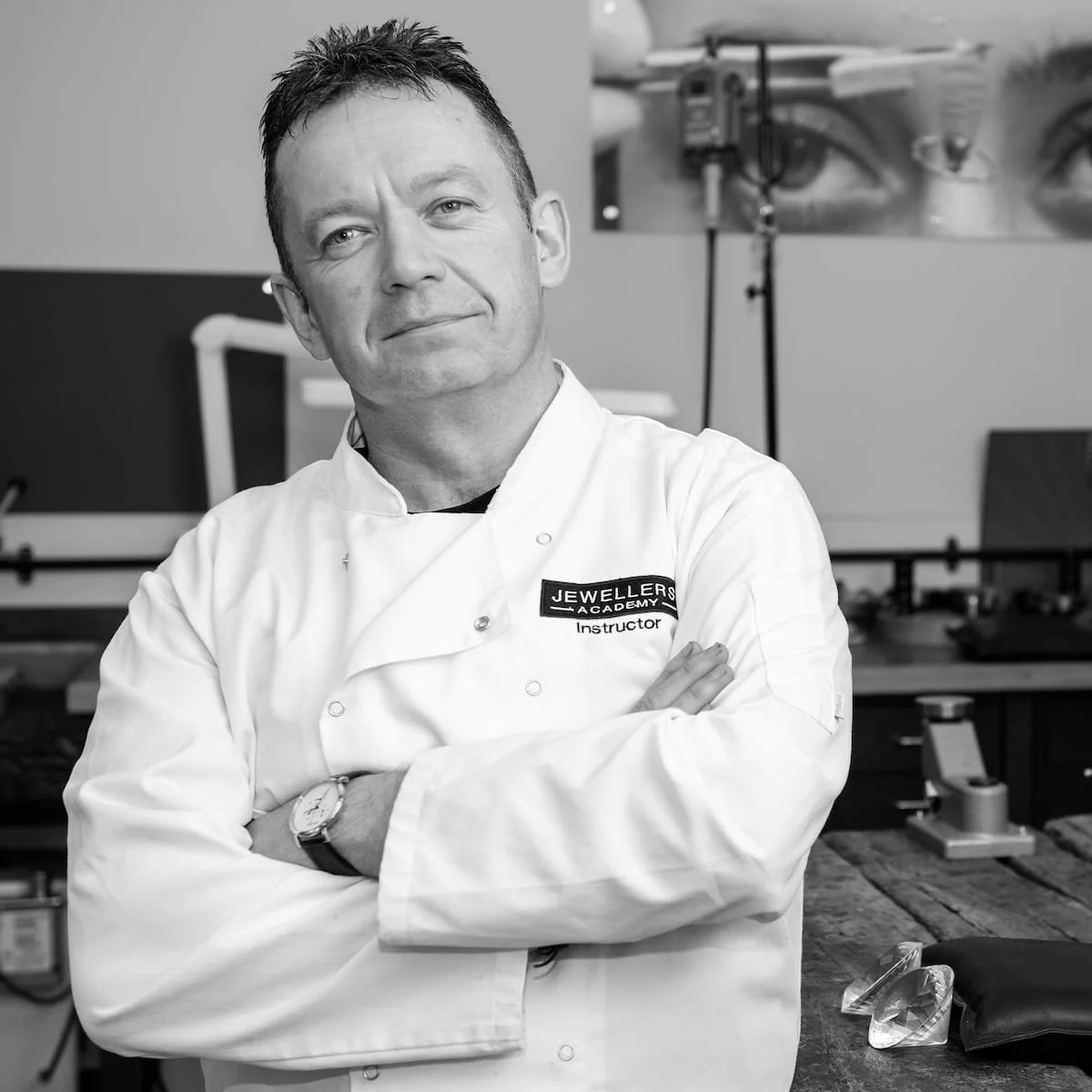
"We must help new recruits to the industry and encourage the next generation – it’s so important they know there is a guiding hand to support them when they need it.“
The Interview
Winning 2024 NAJ Service Supplier of the Year (and a UK Jewellery Award in 2023) in the first few years of a refurbished/expanded training centre is something dreams are made of. The doors these awards open are unbelievable. It’s publicity from these awards that helps the jewellery sector to realise how important training is – or at least, lets people know training centres exist. The tradesperson is a major cog in the industry’s wheel – something I have a strong opinion about after 30+ years in the trade. I’m a goldsmith/Swiss trained watch/clockmaker, born in Northern Ireland in 1970 into a family jewellers headed by a goldsmith/watchmaking father. My two brothers, my sister and I grew up helping in the business – the boys in the workshop and my sister behind the counter in the retail shop. By 11, I could assess and completely service a grandfather clock. No big deal then, but looking back, I’m quite impressed!
A DYING CRAFT
In the ’70s, mechanical watches and clocks were plentiful, so there was lots of work for the many watchmakers. Each Friday evening within 40 miles of the business, we’d deliver mechanical watch repairs to around 10 – pretty old – watchmakers working from their homes. But it was a decade of rumours and misleading information about the future of watchmakers with the arrival of the quartz watch. The new technology would, apparently, “no longer display the problems that mechanical watches would.” Watchmakers’ days were numbered. Watchmaking apprenticeships or training took a dive, and as the old men retired or died, there was no one to take their place. After my O levels, I worked for my dad for a year, but I realised I would not learn much more than clocks as my dad didn’t have time to teach me watchmaking or goldsmithing. And if he did “who was going to fix his clocks?!” It was time to move on, but I wanted to learn from the best, wherever they were! One day, a sales rep walked into the shop and mentioned an “amazing” Swiss watchmaker training centre in Dublin. My ears pricked up and my life changed.
SWISS TRAINING
The Irish/Swiss Institute of Horology, Dublin, was one of 32 training centres set up globally by the Swiss watch industry in the 1960s. At the time, the Swiss watch industry had about 94 per cent of the global watch market and considered other European watchmakers inferior, producing poor repairs/ workmanship. So the Swiss industries collaborated with other nations’ governments to invest in training centres to produce quality watchmakers. Swiss instructors in each centre trained local watchmakers to become high end instructors, shadowing them for two to three years. The best Swiss watch manufacturers supplied many models of movements to train on; the Swiss tools and equipment industry supplied the tools.
The Swiss training process was simple: study each model of watch, learn how to make adjustments, understand the effects of those adjustments on the watch, service, oil and rebuild... several times. For a test, the instructor would install faults in the watch for the trainee to identify, repair and service... under a time restriction. This commercial training was exciting, scary, pressured and worrying, but soon we got used to it, and it made us listen and study each watch more, ask more questions, practice more. Everyone improved quickly and became faster and more efficient while maintaining excellent standards – marking was pretty hard. This is still how the Swiss train today.
The training centre was rigorous, demanding respect and professionalism; each trainee wore their branded white jacket with pride, and the workshop was spotless at all times – everything in its place. As young men and women, we very quickly grew up. Training was strict. If something wasn’t correct, we had to “do it again” and “again,” until it was up to standard... we soon learnt. Of the 13 that started, six qualified. On graduation day, I was incredibly proud of what I’d achieved. That training instilled in me the importance of workshop standards, consistent quality of work and respect for the item in hand. That foundation training inspired the system and approach I have adapted and evolved for the training of gold/silversmiths at the Jewellers Academy.
CONTINUE EDUCATION
The best advice my father ever gave me was to continue my goldsmithing studies while I was still young, so, at the recommendation of the then-NAG, I went to Manchester for four years to do just that. I graduated in 1995 and, shortly after, opened a small outlet in the city, repairing jewellery and anything horological. Business went very well and within 12 months, it had doubled – even though I was doing all the work myself. A few years after graduating, I realised that former watchmaking and gold/silversmithing colleagues were lacking in knowledge of each other’s trade. I began to train a few people, usually at the weekends. Over the years, my training sessions caught on, and strangers started calling, seeking help. I found most traders had formal training in one discipline and were self-taught in others. Between 1995 and 2000, I trained friends and colleagues – tradespeople grateful to learn while retaining their employment. I still had two retail businesses in Manchester, but training was my sideline, my new love – it was so rewarding. I’d found my calling.
CONSTANT DEMAND
Demand for training grew steadily, even without advertising, so in 2013, we expanded into a refurbed purpose-built workshop in one of the retail business’s upper floors to give a more professional feel to training. I continued to draw on my Swiss watch industry training and tailored that approach to suit silver/goldsmith training, and the students kept coming. We were upskilling watchmakers to Rolex standard, upskilling goldsmiths and guiding newbies into the trade. The system was working with amazing results. Once again, we invested in a refurb, creating in 2018/19, state-of-the-art workshops over the three upper floors of a retail shop I’d purchased a few years earlier in the lovely little coastal town of Bridlington, East Yorkshire, from a family friend who was retiring. But just before we opened the new training suite, Covid hit.
As businesses worldwide closed their doors, we contacted global brand tools and equipment manufacturers, explaining our ethos and purpose and giving them the chance to be affiliated with our training centre. Every company we approached came on board, to the exclamations of “The industry urgently needs this. Yes, we want to be involved.” These companies are global leaders in their sector. We are just a small set of workshops in Bridlington.
Soldering at Jewellers Academy
After Covid, we launched our first set of courses on social media and sold out five times over in a few hours. The courses vary from practical to theory- based subjects, including ledgering/bookkeeping, retail law, gemmology... everything a business needs to upskill and succeed.
In our 40-week course (one day per week), we train newcomers from the beginning, encouraging them to practice at home between sessions. Many have other jobs, either in the trade or another profession and want a change. While learning about repair and restoration, trainees make items to practise on, firstly from scrap metal by smelting and forming, then we simulate wear/damage. Manufacturing setting collets, chain ends, bails, gate bracelet links, shanks and wedding rings, tubing, etc. all use traditional skills, which is very important. These courses mean we can retain skills in the industry, and trainees learn to really respect the pieces they work on. The theory is if they can make it, they can repair it. Sustainability is also very important.
Exams cover all topics on the syllabus. For 12 months after graduation, we offer trainees four free days
for them to iron out any issues and struggles or simply to further their training. The best student of each 40-week course receives £1,500 of tools and equipment of their choice. We must help new recruits to the industry and encourage the next generation – it’s so important they know there is a guiding hand to support them when they need it.
We now have social networks for classes/groups to keep in touch with each other, and to encourage the cohorts to help rather than compete with each other. The groups certainly also help with mental health, which I believe is a big problem in our industry. I don’t pretend to know anything about it, but friendship, talking and letting people know we are in this industry together with the same technological problems, can surely only help. Also, I strongly feel the industry must improve working conditions and increase wages to attract the new generation.
Derek Boyd, Founder of Jewellers Academy
We will be announcing more course dates in the next few months so if you're interested in applying for any upcoming courses you can find more information here.